Review 039 · Power Banks & Batteries
Replacement Tool Batteries for Milwaukee, Makita and EGO Tools
Four replacement batteries from one brand, each built for a different tool platform, and the one number that decides whether they suit your drill.
 Charge · buyer's guide
At a glance
-
We recommend
- Best for light jobs with a Milwaukee 12V tool you already own.
- Skip it if you need the full runtime of a true 3.0Ah battery.
4.6 (1,980 ratings)$21.98Power Up on Amazon -
Recommended, with caveats
Waitley 12V 3000mAh Battery and Charger Kit
- Best for a 12V owner who has no charger and no spare battery.
- Skip it if you already own a charger and just need batteries.
4.6 (26 ratings)$35.99Power Up on Amazon -
Recommended, with caveats
Waitley 18V 6.0Ah 2-Pack for Makita
- Best for Makita 18V owners who want long runs between charges.
- Skip it if you need a battery with proven field results.
4.6 (35 ratings)$59.98Power Up on Amazon -
Recommended, with caveats
Waitley 56V 5000mAh Battery for EGO
- Best for an EGO owner who needs one spare and can check the fit.
- Skip it if one in six low ratings bothers you.
4.1 (33 ratings)$79.98Power Up on Amazon
When the only spare battery is flat
The drill dies halfway through the last shelf bracket. The spare battery is flat too, the charger is humming away on the workbench, and the nearest hardware store closes in twenty minutes. Anyone who owns cordless tools has been there, and it is the moment a second battery starts to look like a good idea.
Four replacement batteries from one brand, Waitley, are covered here. None of them is made by the tool brands. Milwaukee, Makita and EGO appear only as the platforms these batteries are built to fit, and each one fits a single platform and nothing else.
The first is a pair of 12V 3.0Ah batteries for Milwaukee tools. The second is a 12V kit for the same platform that adds a charger. The third is a pair of 18V 6.0Ah batteries aimed at Makita tools, and the fourth is a single 56V 5000mAh battery for EGO tools.
The split between them is mostly about proof. The Milwaukee pair has close to two thousand ratings behind it. The other three have a few dozen each, and that gap matters more than any spec in the description.
If you are choosing, start with the platform printed on your tool. Then look at the capacity number, and then at how many buyers have weighed in. Each section below says what the battery does well, where buyers pushed back and who should shop elsewhere.
Waitley · 12V 3.0Ah batteries for Milwaukee tools, 2 pack
The two-pack that keeps a 12V drill running
Datasheet · from the Waitley page
| Model | M12 |
|---|---|
| Capacity | 3 amp_hours |
| Voltage | 12 volts |
| Amps | 3 A |
| Count | 2 Count |
| Size | 1.81 x 2.01 x 3.39 inches |
| Weight | 200 g |
| Battery | Lithium Ion |
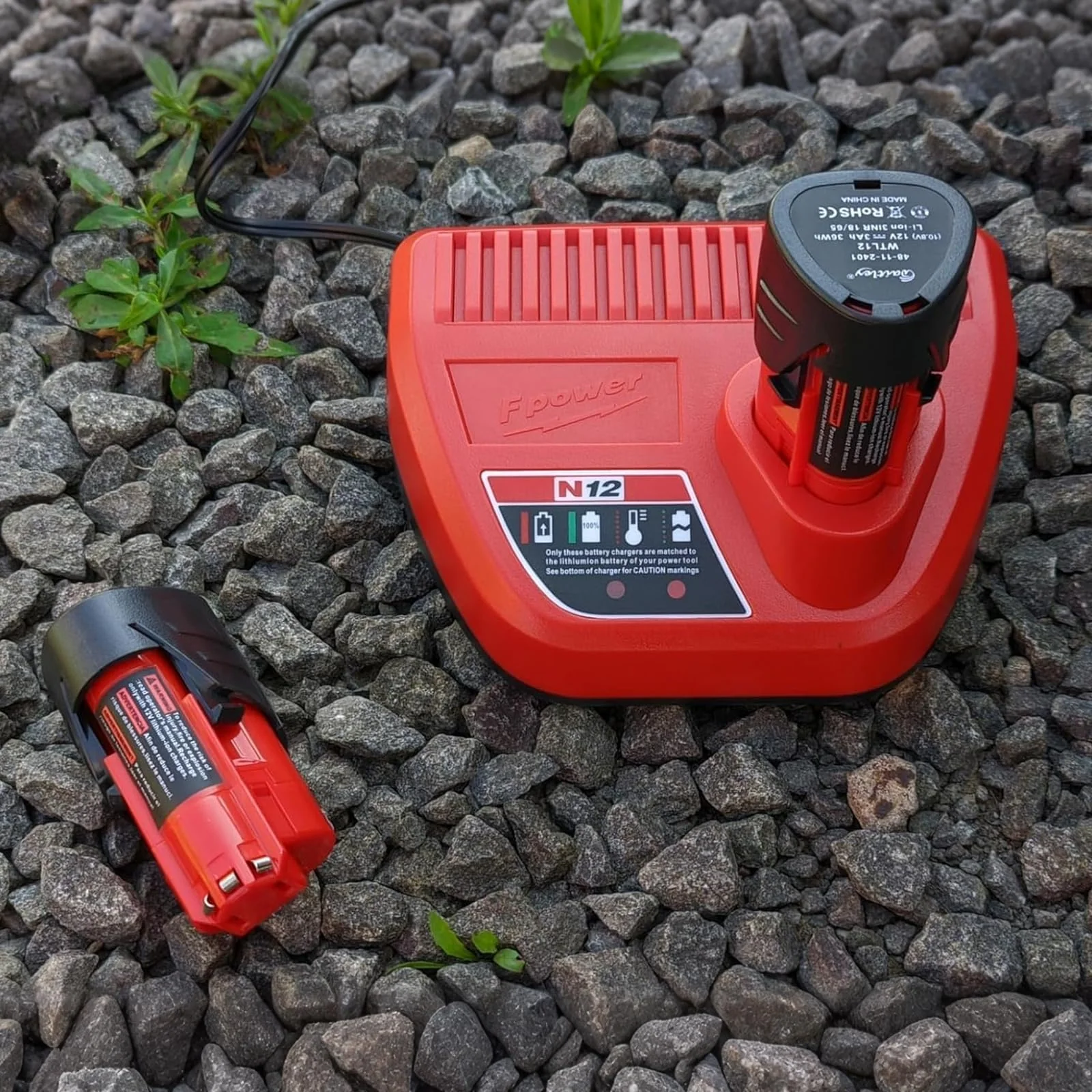
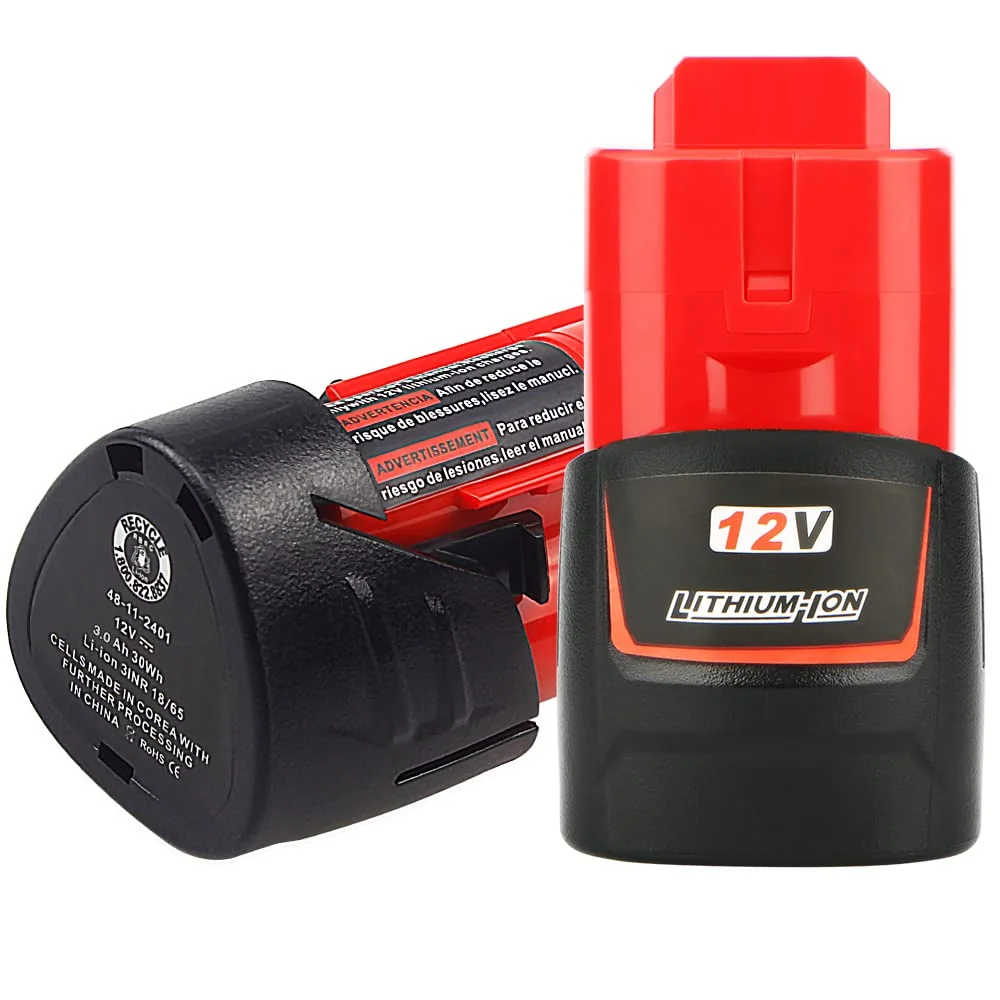
The two-pack for Milwaukee 12V tools is the best documented battery in this group. Waitley lists lithium-ion cells, 12V, 3.0Ah and the model name M12. It says the batteries are compatible with original tools and chargers.
The product page gives each battery as 1.81 by 2.01 by 3.39 inches and the weight as 200 g. The brand makes the usual protection claims: a built-in microchip to prevent overcharging and other malfunction, and shock absorbing features. Those are Waitley's claims, and no buyer review confirms or contradicts them.
Buyers like the fit. One reviewer bought them for a Milwaukee vacuum found cheap without batteries, and used it in a camper for five weeks, vacuuming every couple of days, without running out.
That reviewer also liked that they are not bulky or heavy, so the vacuum still reaches tight spots. A second says they work with original Milwaukee chargers. A third found they charged quickly in the Milwaukee charger and ran a decent length of time in M12 tools.
Work as well as OEM batteries, but deff not 3Ah.
The complaint to take seriously comes from a four-star reviewer. They say these work as well as original batteries but are not 3Ah, and that they last about as long as a Milwaukee 1.5Ah. That fits a vacuum used a few minutes at a time better than it fits a drill driving long screws.
The star picture is steady. With 1,980 ratings and an average of 4.6, most buyers are happy, though about one in twenty-five gave a single star. The written reviews we have are all positive or mild, so the stars do not say why.
Who should buy it: someone with an M12 tool and a working charger who wants a second battery at $21.98 for the pair. Who should skip it: anyone who plans to run a tool hard for long stretches, or who needs the runtime printed on the box. We recommend it for light and moderate work, and we would treat the capacity number as a ceiling.
What buyers wrote about the Waitley 12V 3.0Ah 2-Pack
4 out of 5 More like 1.5A
Work as well as OEM batteries, but deff not 3Ah. Lasts as long as a Milwaukee brand 1.5Ah, but for $20 can’t complain much
5 out of 5 Great Batteries to Use with Milwaukee Vacuum
I picked up a Milwaukee vacuum and charger for cheap locally, but it didn't come with the batteries. I didn't know if it worked, so I didn't want to purchase expensive name brand batteries. I bought these to test out the tool and charger, and they are way better than I expected for the price! I've been using the vacuum with these batteries in my camper for 5 weeks (vacuuming every couple days) and they lasted the whole time. I love that they're not bulky or heavy so the vacuum still fits in all the tight spots of the camper without being awkward. They fit perfectly and are easy to put on and remove.
5 out of 5 Milwaukee Style M12 Batteries.
I was very pleasantly surprised with my battery purchase. The batteries fit well with my Milwaukee M12 tools and seem to have a decent battery run time. The batteries seemed to charge very quickly with the Milwaukee battery charger with no issue experienced. Overall I was pleased with the performance and would recommend purchasing these batteries within the future.
5 out of 5 Wworks with my orignal Milwaukee charges
Great value for the price, and they work with my original Milwaukee chargers. I would definitely recommend them.
Waitley · 12V batteries and charger kit for Milwaukee tools
The kit for a 12V tool with no spare gear
Datasheet · from the Waitley page
| Warranty (brand) | 1 year's warranty from order date |
|---|---|
| Capacity | 3000 milliamp_hours |
| Battery | Lithium Ion |
Works with / fits
Tool batteries replaced: M12, 48-11-2401, 48-11-2411
From the Waitley product page
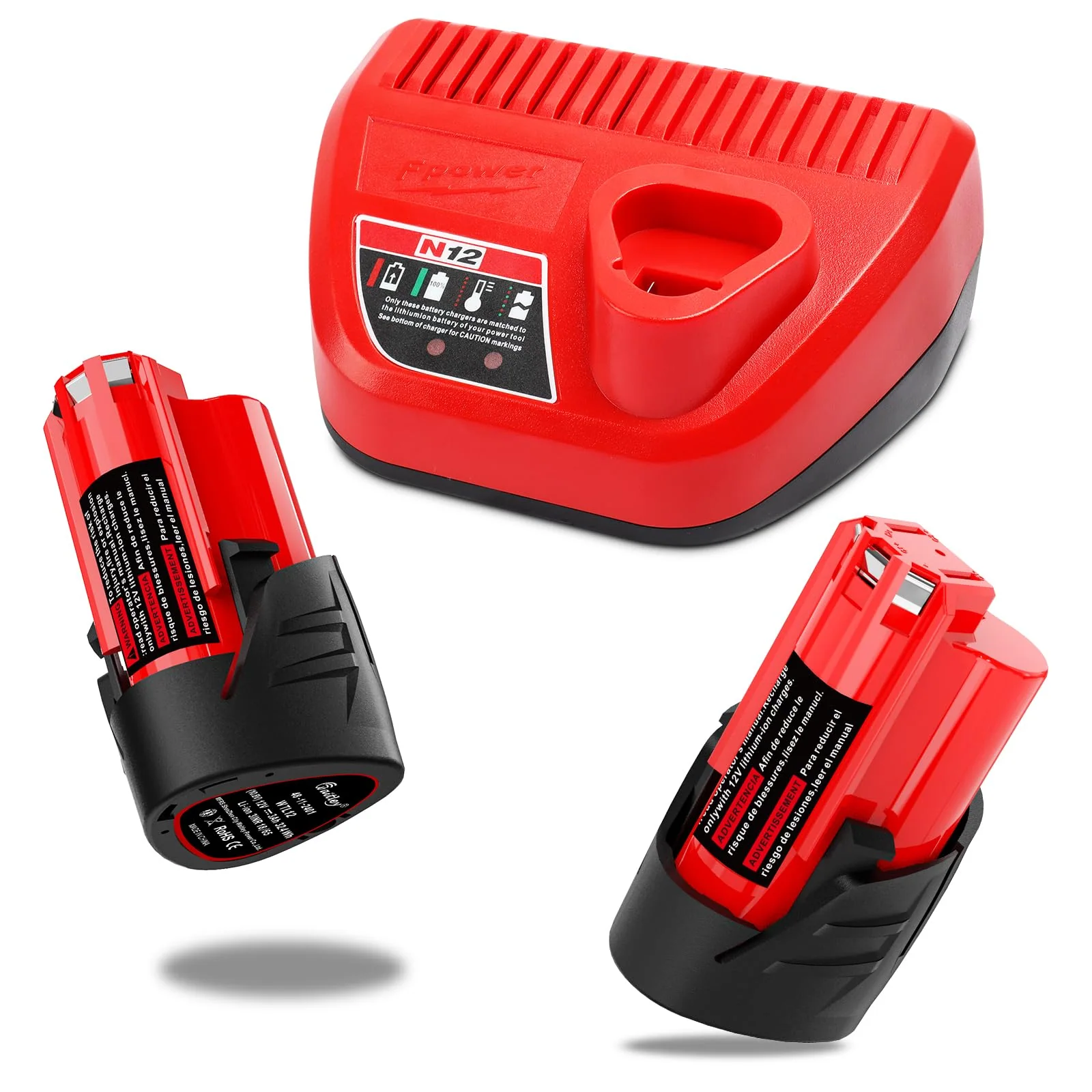
This is the same platform as the first two-pack, sold as a kit: two 12V 3000mAh batteries and a charger. Waitley says the combo works with M12 tools and names models 48-11-2401 and 48-11-2411. It also states plainly that the kit is Not Made in Milwaukee, which is the honest way to describe it.
The product page shows a one-year warranty from the order date, a weight of 500 g and lithium-ion cells. Waitley says the charger has intelligent protection against overcharge, overheat and short circuit. That is the brand's claim, and no buyer review in front of us tests it.
The brand also describes steady output across drilling, fastening and maintenance work. That is a marketing line more than a spec, and it gives you no number to hold the kit to.
The buyer record is thin. The kit has 26 ratings and an average of 4.6. About seven in eight are five stars and one in fourteen is a single star.
No written review is available to explain either end of that spread, and critical reviews with details are few. A short rating history does not make a product bad. It does mean you are betting on the brand's description more than on other owners' experience.
The kit makes sense in one situation. You own a Milwaukee 12V tool and have neither a spare battery nor a charger, or your charger is broken. A kit then saves a second purchase, and we suggest reading the charger's label when it arrives to confirm it matches your outlet and the battery's voltage before the first charge.
It makes less sense if you already have a charger. The two-pack reviewed first is built for original chargers, so it covers the same need with a longer record. We call the kit conditional: a fair choice for a starter setup, and not our first pick for someone who only needs batteries.
Waitley · 18V 6.0Ah batteries for Makita tools, 2 pack
Big 18V capacity, thin buyer record
Datasheet · from the Waitley page
| Model | WTL1860 |
|---|---|
| Warranty (brand) | 1 Year |
| Capacity | 6 amp_hours |
| Voltage | 18 volts |
| Count | 2 Count |
| Battery | Lithium Ion |
Works with / fits
Tool batteries replaced: BL1860B
From the Waitley product page
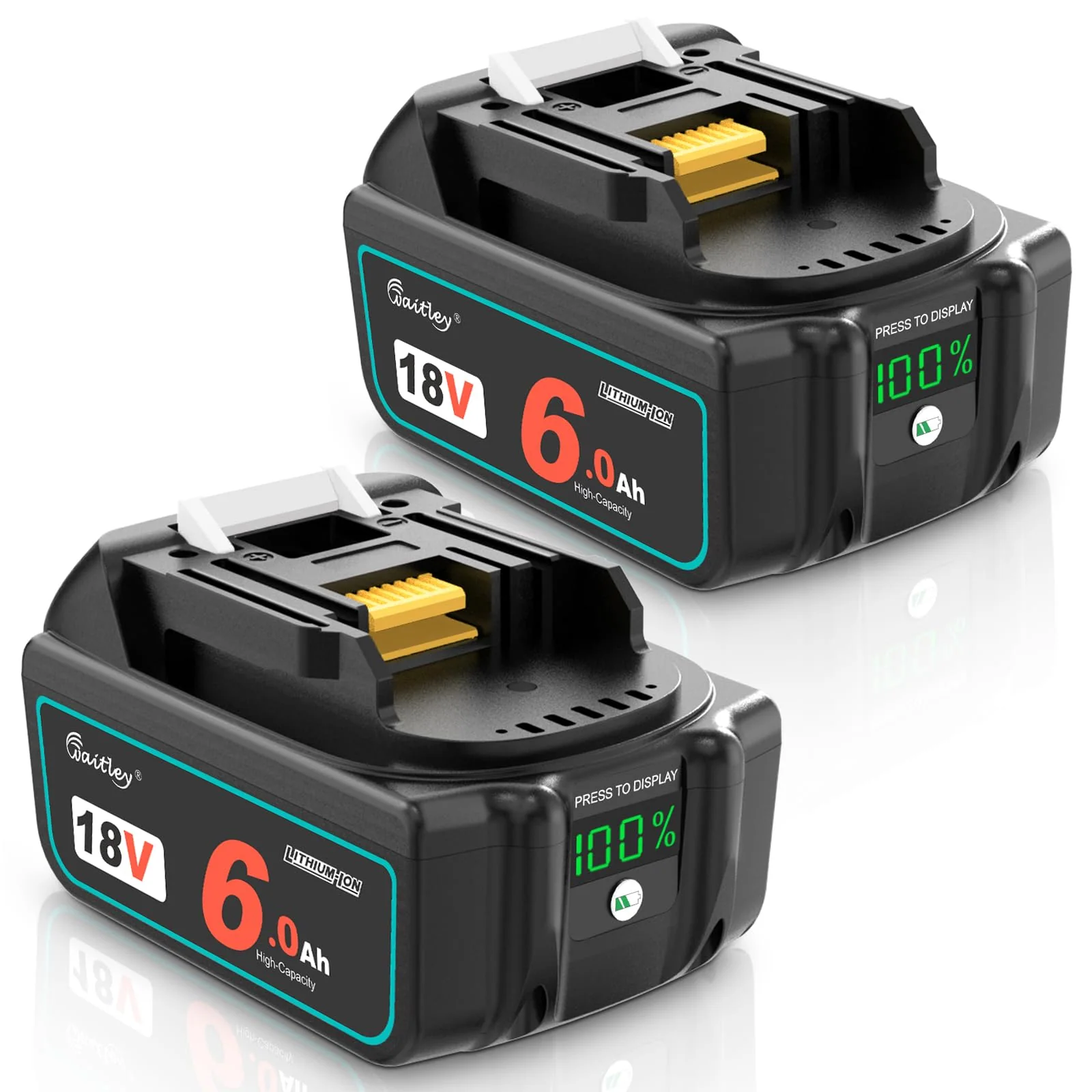
The Makita pair is the capacity play of the group. Waitley lists 18V and 6.0Ah, or 6000mAh, in a two-pack under model number WTL1860. The title says it is compatible with Makita BL1860B tools.
The product page names the BC, BD, BH and BJ tool series, plus chargers DC18RA, DC18RC, DC18SD and DC18SE. It lists CE, FCC and RoHS certification. It also describes a protection board against wrong voltage, overcharge, over-discharge, over-current and short circuit.
A percentage-based LED indicator shows the charge state, and the brand adds a one-year warranty. The weight is given as 0.6 kg. All of that is the brand's statement.
What buyers say is almost nothing. The pair has 35 ratings and an average of 4.6. Nearly three in four ratings are five stars and about one in five is four stars.
A small slice gave one or three stars, and no written review explains why. Evidence on runtime and long-term life is not here yet.
Six amp-hours is the figure that will draw you in, and it is also the one to be careful with. The Milwaukee two-pack shows that a stated capacity and a felt capacity can differ, because one reviewer there says those batteries run like half their label. Nothing here shows that for the Makita pair, and nothing rules it out.
The pair suits you if you own an 18V Makita tool in one of the named series, you want long runs and you accept a newer product. It does not suit you if you want proof before you spend $59.98. The honest comparison is with the other 18V option you would consider, which may already have years of owner reports.
Our read: conditional. If the first battery seats firmly and charges in your own charger, you will probably be fine. If the fit feels loose, send it back.
Waitley · 56V 5000mAh battery for EGO tools
A single 56V battery with the weakest ratings
Datasheet · from the Waitley page
| Model | RYG08L |
|---|---|
| Warranty (brand) | 1 Year |
| Voltage | 56 volts |
| Size | 6.18 x 3.58 x 7.67 inches |
| Battery | Lithium Ion |
Works with / fits
Tool batteries replaced: BA2800T, BA2800, BA4200, BA1400
From the Waitley product page
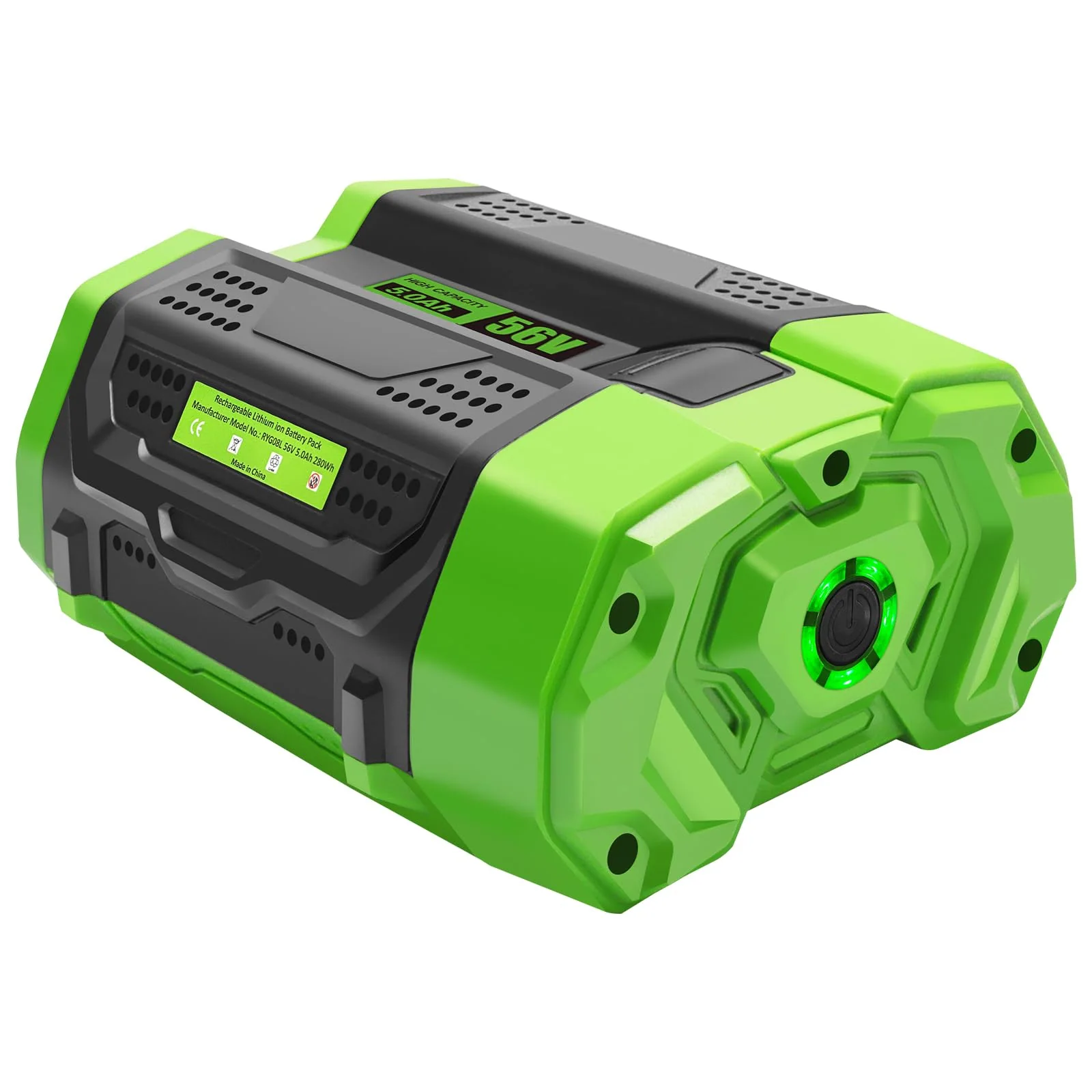
The EGO battery is a single 56V unit, and it is the largest and heaviest one here. Waitley lists 5000mAh, model number RYG08L, a weight of 4.2 pounds and dimensions of 6.18 by 3.58 by 7.67 inches. It calls the battery a replacement for the 56V 5.0Ah models BA2800T, BA2800, BA4200 and BA1400.
The tool list is long. It names the CS1604, CS1804, CS1403, HT2400, LB6504, LB5804, LB6500, LB4800, HTA2000, STA1500, PH1400 and PSA1000 and adds other 56V tools.
That reads like a compatibility chart, but the brand also calls its battery a replacement for several different originals. Check your own battery's model number against the product page before you order.
The brand lists LED indicators for charging and usage status. It adds protection against overcharge, over-discharge, overheating, short circuit, over-current and over-voltage, and says there is no memory effect. These are product page claims.
Support is a 12-month quality issue resolution period, and the details show a one-year warranty. The weakest ratings of the four belong to this battery. The average is 4.1 from 33 ratings.
About three in five are five stars and a quarter are four stars. Roughly one in six are one or two stars, and no written review is available to explain the low ones.
The cause of those low ratings is unknown, so the safest reading is that a meaningful minority of buyers had a problem with fit, life or capacity. A single unit at $79.98 is also a bigger loss if it fails.
There is a case for it. EGO owners with a mower or trimmer who need one more battery for a big yard may accept the risk, since the product page names a long tool lineup and a one-year warranty.
There is also a case against it. If you can wait for a battery with a stronger record, do. We rate it conditional, and we would not choose it for a tool you depend on for work.
How the four batteries differ
| Spec | Waitley 12V 3.0Ah 2-Pack | Waitley 12V 3000mAh Battery and Charger Kit | Waitley 18V 6.0Ah 2-Pack for Makita | Waitley 56V 5000mAh Battery for EGO | Also reviewed · MiadyMiady 20000mAh 22.5W Power Bank 2-Pack |
|---|---|---|---|---|---|
| Price | $21.98 | $35.99 | $59.98 | $79.98 | $32.99 |
| Rating | 4.6 of 5 | 4.6 of 5 | 4.6 of 5 | 4.1 of 5 | 4.5 of 5 |
| Ratings | 1,980 | 26 | 35 | 33 | 5,763 |
| Best for | light jobs with a Milwaukee 12V tool you already own | a 12V owner who has no charger and no spare battery | Makita 18V owners who want long runs between charges | an EGO owner who needs one spare and can check the fit | two people sharing a trip with no outlets nearby |
Platform comes first, because none of these crosses over. The Milwaukee pair and the Milwaukee kit are both 12V, the Makita pair is 18V and the EGO battery is 56V. One built for another platform will not do anything useful on your tool, so the label on your tool decides before price or capacity enters.
Capacity is where the brand's numbers split. The two Milwaukee products both say 3.0Ah, the Makita pair says 6.0Ah and the EGO battery says 5.0Ah. Those figures are the brand's statements.
One buyer of the Milwaukee pair says those batteries behave like a 1.5Ah original. Treat each stated capacity as the upper end of what you will get.
The buyer record differs even more. The Milwaukee pair has nearly two thousand ratings, and the other three have a few dozen each. A strong average on thirty ratings is a hint, while the same average on two thousand is a pattern.
Count matters too. The Milwaukee pair, the kit and the Makita pair give you two batteries each, which lets you work with one while the other charges. The EGO product is a single unit, and if you drive one tool all day, two batteries are worth more than one big one.
So the order is simple. The Milwaukee two-pack has the best evidence, the Makita pair has the most capacity on paper, the kit is the only one that includes a charger, and the EGO battery carries the most doubt.
Other ways to solve a dead battery
A replacement from the tool brand itself is the obvious alternative. It is better when you rely on the rated runtime, when a tool warranty could be affected by a different battery, or when the tool is your income. You pay more for that peace of mind, and many buyers of third-party batteries decide the trade is not worth it for weekend use.
A second charger beats a second battery in one case: when the wait is for the charger itself to be free, because two tools share one. If the problem is that a battery runs flat mid-job, a spare charger on the other side of the shop does not help. A spare battery does.
A lower-capacity battery is the better fit when weight and balance matter more than runtime. The Milwaukee two-pack buyer who vacuumed in a camper liked how small these batteries are. The 6.0Ah and 5.0Ah ones here are larger and heavier by the brand's own dimensions, and a small tool can feel awkward with them.
There is also the option of checking the old battery. A battery that charges and runs short may be a charger or contact problem, not a dead cell. That is worth a look before spending anything, though a battery that is swollen, hot or leaking should be retired, as the safety guidance below explains.
For a corded tool, none of this applies. A corded drill never runs out of charge, and it is the right answer for a garage bench where an outlet is always nearby. It loses the moment you need to climb a ladder or work in a yard.
What buyers say
Waitley 12V 3.0Ah 2-Pack
4.6 (1,980 ratings)Waitley 12V 3000mAh Battery and Charger Kit
4.6 (26 ratings) 300+ bought in past monthWaitley 18V 6.0Ah 2-Pack for Makita
4.6 (35 ratings) 50+ bought in past monthWaitley 56V 5000mAh Battery for EGO
4.1 (33 ratings) 50+ bought in past monthWritten buyer reviews exist for only one of the four products, the Milwaukee two-pack. The kit, the Makita pair and the EGO battery have star counts and nothing else. What follows leans on that one product and on the stars for the rest.
Praise for the Milwaukee pair clusters around three things. Buyers say the batteries fit their tools, they work in original chargers, and the price is low for two. One owner used a vacuum with them every couple of days for five weeks, which is a real-world report of steady use.
The one criticism is about capacity. A four-star review says they work as well as original batteries but run like a 1.5Ah, not a 3Ah. No other review in the group repeats that, so it is a single report, though a believable one given the way the batteries are sold.
Across the whole group, the stars tell a plain story. The Milwaukee pair has the largest sample and most of its buyers are happy. The kit and the Makita pair sit at the same average on far fewer ratings.
The EGO battery has a clearly lower average and the highest share of one and two star ratings, about one buyer in six. Critical reviews are few, so all we can say is that dissatisfaction exists there and not what it is about.
I love that they're not bulky or heavy so the vacuum still fits in all the tight spots of the camper without being awkward.
Ideal replacement solution for your daily repair, installation, and DIY needs. Not Made in Milwaukee
Ratings, star breakdowns and “bought in past month” figures were read on the product pages on November 16, 2026.
How to charge and store a lithium-ion battery
Whichever battery you buy, the safest habits are the same, and the U.S. Fire Administration lays them out for lithium-ion batteries. It says to store them at room temperature when possible, and not to charge them at temperatures below 32 degrees F or above 105 degrees F.
The agency also says to stop using a lithium-ion battery if you notice an odor, a change in color, too much heat, a change in shape, leaking or odd noises. For storage, it says to keep spares away from anything that can burn, and not to leave them in direct sunlight or a hot car, which it calls a fire risk.
When a battery is finished, the agency says not to put lithium-ion batteries in the trash and to recycle them at a local battery recycling location. If you fly with spares, it says to remove loose lithium-ion batteries from checked luggage and keep them with you on the plane.
The brands' own claims about protection circuits are theirs, and they do not replace those habits. Before you charge a new one, check that it matches the platform on your tool and the charger you plan to use.
- Match the battery to your tool's platform and voltage before buying.
- Seat it firmly and confirm it clicks into the tool and the charger.
- Charge it in a room between 32 and 105 degrees F.
- Stop using any battery that smells, changes shape, leaks or runs hot.
- Store spares at room temperature, away from anything that can burn.
- Recycle a dead battery at a recycling location, not in the trash.
Which one we would pick
We recommendWaitley 12V 3.0Ah 2-Pack
Nearly 2,000 ratings, a strong star average and steady praise for fit make it the safest pick here, as long as you expect modest runtime.
Power Up on AmazonRecommended, with caveatsWaitley 12V 3000mAh Battery and Charger Kit
A sensible starter kit on paper, but the buyer record is thin, so it suits people who want everything in one box and accept that.
Power Up on AmazonRecommended, with caveatsWaitley 18V 6.0Ah 2-Pack for Makita
The specs and the star average look good, but only a few dozen buyers have rated it, and none of the written reviews cover it.
Power Up on AmazonRecommended, with caveatsWaitley 56V 5000mAh Battery for EGO
It has the lowest star average of the four and the highest share of one and two star ratings, so match your model number twice before ordering.
Power Up on AmazonFor a Milwaukee 12V owner who already has a charger, we recommend the two-pack. It has the strongest buyer record by a wide margin, buyers praise the fit, and the main complaint is about runtime on heavy jobs, which light users can live with. Treat the capacity label as a ceiling.
For a Milwaukee 12V owner starting from nothing, the kit is a fair choice with an asterisk. It saves a second purchase, but only a few dozen buyers have rated it and none have written anything we could read. We would pick it if convenience matters more than evidence.
For a Makita 18V owner, the 6.0Ah pair is tempting. The specs and the star average look good, and the long list of named chargers is a plus.
We don't recommend it if you need proven field results, because the record is short. Try one in your tool before you commit to it for a job.
For an EGO owner, we are the most cautious. The battery has the lowest average here, and about one in six buyers gave one or two stars with no written reason.
We don't recommend it for a tool you rely on for work. If you need a spare and can return it, check the fit and watch how it behaves in the first few charges.
Questions buyers ask
Which is better for a Milwaukee 12V drill, the two-pack or the kit?
The two-pack is better if you already own a charger, because Waitley says it works with original tools and chargers and it has nearly 2,000 ratings behind it. The kit adds a charger but has only a few dozen ratings, so it is better for a first-time setup.
Do the Waitley 12V batteries really give 3.0Ah?
Waitley lists 3.0Ah for the two-pack and 3000mAh for the kit. One buyer of the two-pack says it works like a Milwaukee 1.5Ah, though as well as original batteries. Treat the stated capacity as a ceiling, and expect shorter runs on heavy work.
Is the Waitley 18V 6.0Ah pair good for Makita tools?
The pair is built for Makita 18V tools, and the product page names the BL1860B, the BC, BD, BH and BJ series and chargers such as DC18RA. Its star average is 4.6, but only a few dozen buyers have rated it. We call it a conditional pick.
Will the Waitley 56V battery fit my EGO tool?
It may, if your tool is one of the 56V models the product page names, such as the CS1604, HT2400 or LB6504. Match your own battery's model number against the replacement list there first. It has the lowest rating of the four, at 4.1.
How should I store spare lithium-ion tool batteries?
Store spares at room temperature, away from anything that can burn, and out of direct sunlight and hot cars. The U.S. Fire Administration gives all three rules and warns that heat and sunlight are a fire risk. It also says not to charge below 32 degrees F or above 105 degrees F.
Can I throw away a dead tool battery?
No. The U.S. Fire Administration says not to put lithium-ion batteries in the trash and to recycle them at a local battery recycling location. Stop using a battery that smells, leaks, swells or overheats, and take it there instead of keeping it as a spare.
Sources
This review touches on electrical, fire or indoor-air safety. It is general information, not professional advice: follow the product's manual, and ask a licensed electrician or HVAC technician about wiring, circuits and installation.
- Battery Fire Safety, U.S. Fire Administration (USFA, FEMA). Read November 16, 2026.
Same circuit
More charge and nearby reviews
Miady Power Banks Reviewed: 20,000mAh, Mini and Magnetic
Three Miady banks, from a 20,000mAh pair to a pocket mini, and which one suits the phone you actually carry.

Miady Solar Power Bank and 3-in-1 Wireless Charger Reviewed
One Miady charger stores power for the day the grid fails. The other only tidies the nightstand, and the two are easy to mix up.
Xbox Controller Battery Packs and Charging Docks Compared
Three rechargeable kits for Xbox controllers, from a four-pack dock to USB-C packs with covers, and the household each one fits.